

What if politicians had to think about their impact on future generations before passing laws?
Well well well, if it isn't the consequences of our own actions.

International climate conferences won’t inspire hope - we have to look elsewhere.
Commenting on how important it is that you Do That Thing, and still not Doing That Thing, doesn’t work. Criticising other people for not also Doing The Thing, and complaining that it’s unfair that you’re being criticised for not Doing the Thing when nobody else is either, doesn’t work. Pointing out that there are circumstances in which Doing The Thing would lead to knock-on problems and therefore we should stick with the current, worse problem, doesn’t work.
Yet this is every single international climate conference I have worked on, or followed in the news. Countries are nowhere near reaching the Paris Agreement goals. We have passed the 1.5 heating limit. We have passed the first tipping point.

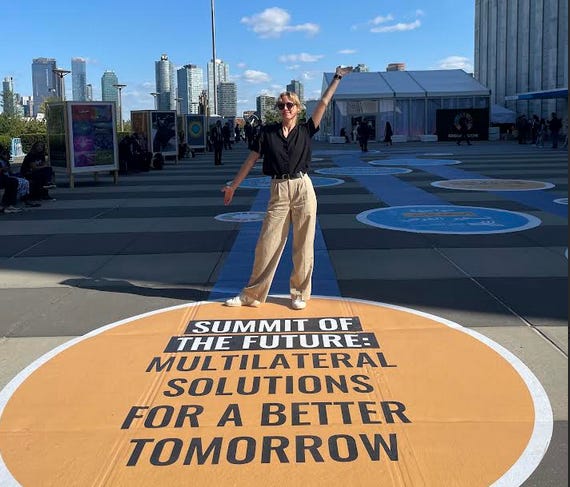
COP30 (the UN climate change conference) is starting soon. I went to COP26, I worked on COP28, both crushing, soul-destroying experiences - perhaps because I still expected something of world leaders?
I assumed a nonsensical power structure dominated by fossil fuel lobbyists and male career politicians might still benefit those who aren’t even allowed in the room.
But now I see these conferences as liminal spaces - that is, something separate from the real world, devoid of connection to past and present, in an airless conference centre where you can’t feel the unseasonable heat or hear the protestors. They’re like a ritual, or a doctor’s appointment. This country reiterates its commitment to Doing Something, that other country is mad that they have to Do Something too, the agreements are weak, and columnists are outraged. Etc etc.
Politicians are perpetually in the liminal space, the waiting room, neither fulfilling their historical responsibility nor preparing for the future. They are not part of my world and I refuse to let them ruin my day as well as the planet.
Outside the conference halls, the real world ticks on. In the community centres and NGO offices and home offices and low-budget meeting venues with no air-con, the real seeds for the future are being planted.
I’m not here to sell false hope, or to pretend that the stakes aren’t monumental, but to say that I have worked on multiple COPs and my only conclusion is good things are happening everywhere, and we must give them more attention. The failings of politicians take all the air out of the room and all the space in the newspapers, and can create the illusion that we have no future, when we have many many many futures to choose from.
You’re invited! Brussels Climate Coffee - 7th November

Come join The Green Fix Brussels team for a climate coffee break on the 7th November in MIR Concept! It’s an open space to meet, discuss any struggles and successes you’re facing in your climate action efforts, and take a needed break from these chaotic times. RSVP for free here.
What’s Going On?
Election wins: Netherlands votes in first openly gay and progressive prime minister, and Ireland elects left-wing pro-Palestine independent president.
The richest 0.1% emit more in one day than someone from the poorest 50% emits in a year.
AI assistants misrepresent news stories 45% of the time, study finds.
Court rules that TotalEnergies is guilty of greenwashing in its adverts.
Climate change made Hurricane Melissa four times more likely.
We recently launched A Rough Idea, an extra newsletter supplement for paying subscribers on navigating your values in a capitalist society. We also have gift options and free trials available for low-income readers - just message us, we won’t ask you to prove it.
You can also support The Green Fix by tipping us a virtual coffee, or sharing our content with your networks.
Focus On: Future Generations Thinking
This is the first in a series of editions focused on future-building. In this one, Cass talks to Christiny from ZOE Institute about how politicians can think more long-term.
I’m Christiny Miller and I lead work on future-fit governance and future generations thinking at ZOE Institute for Future-fit Economies. ZOE Institute is an independent think tank researching and developing new economic ideas with people and planet at the core.
What is ‘future generations’ thinking? Why does it matter?
Future generations thinking is thinking about how decisions and actions taken today, and specifically policies designed today, will affect the people of the future who are not alive yet. This means looking at long-term impacts and ensuring decisions are not causing harm down the line or creating a mess which future generations will have to clean up.

Of course, the well-being of present generations is also important, so I think it’s better to frame the discussion around “present and future generations” or “intergenerational fairness”.
Intergenerational Fairness is what the European Commission calls its work in this area since last year when it appointed its first Commissioner responsible for this, Glenn Micallef.
Looking backwards, we can see the importance of considering the long-term impacts of actions – and inactions! Imagine if serious climate action had been taken generations ago—in the 1820s when the greenhouse effect was discovered, in the 1890s when fossil fuels were connected to that effect, in the 1970s when the United Nations Environment Programme was established, or in the 1980s when the Intergovernmental Panel on Climate Change was formed.
If previous generations had taken more serious action to prevent the exacerbation of the climate crisis by reducing or eliminating fossil fuels, imagine what the world might look like today.
What does future generations governance look like in practice?
Future generations governance is the practice of making policy with future generations in mind. This can look like a lot of different things, but I would break it down to three main things that policymakers need to do:
Look longer-term to solve the complex challenges of today, e.g., climate breakdown, unsustainable use of resources, poverty and inequality
Work in a more cross-cutting way to connect different topics and reduce harmful trade-offs (i.e. where working towards an objective in one policy area may come at the expense of an objective in another area)
Include methods of meaningful public participation to bring people along and avoid public backlash
Many different tools can be used to extend the time horizon of policymaking. Strategic foresight is one important tool which can help policymakers (and others) explore different possible futures and consider the long-term impacts of decisions.

Impact assessments are another tool to assess the different impacts a policy choice will have across time and across dimensions. Looking further into the future and applying a specific future generations lens can help uncover and reduce potential negative effects.
There are also different methods that can help ensure that policymaking is taking the public’s priorities into account. Citizen assemblies or panels are a really effective way to bring in representative views from across society and create a shared vision, set long-term priorities or even give direct input and feedback on particular policies.
Better coordination between ministries or government departments can also help to make sure policies don’t result in harmful trade-offs and can also help to boost synergies (where policy objectives in different areas can mutually support each other).
By making policy in a way that is focused on the long term, in line with citizens’ priorities, and so that a breadth of policy areas are tackled together, these policies will be better suited to promote the well-being and interests of both present and future generations.
Are there any examples of successful future generations governance we could learn from?
Yes. There are a lot of countries around the world using different tools and practices and models to embed future generations thinking. One of the best examples is Wales.
In 2015, Wales adopted the Well-being of Future Generations Act which put into law seven long-term well-being goals “to create a Wales that we all want to live in, now and in the future”.
This Act also created an independent Future Generations Commissioner whose job is to scrutinise decisions and make sure they are in line with the well-being goals.
It’s only been ten years so it’s a bit early to see the long-term impacts, but the Welsh 2025 Future Generations Report outlines positive progress that has already been made (carbon emissions have dropped 27%).
There are plenty of other international examples to learn from too. The Network of Institutions and Leaders for Future Generations – which ZOE Institute is part of – exists to share knowledge and learning between governments and individuals doing this.
Looking ahead, the European Union is working on its first strategy for intergenerational fairness. We expect it to be finished in Spring 2026. Part of their process has been talking to experts and future generations thinkers from Europe and beyond, so I hope that next year we will also have another positive example.
How can we break the cycle of short-term priorities dominating decision-making and public attention?
Politicians always want short-term wins they can showcase within their term limits and long-term policy-making doesn’t really work that way. However, future generations are still politically relevant; in the last EU elections, nearly every political party mentioned the interests of future generations in their manifestos. I think the public attention is there, the bigger question is how we can set long-term priorities and strategies and then stick to them across election cycles.
Of course, priorities will evolve over time and the specific actions needed will shift, but having a clear vision and long-term goals is at the heart of future generations thinking. Then subsequent politicians need to be accountable for taking actions in line with that, then they can leave their mark by say, enacting something which is a piece in the puzzle towards achieving that vision.
If that vision is made with the input and participation of the whole of society, then politicians may not have the feeling that they are implementing the ideas of their predecessor, but rather that they are implementing the will of the people and acting in the interests of generations yet to come. And as elected officials in a democratic society, this is also their duty.
You can follow ZOE Institute’s work on their website, Bluesky and LinkedIn.
So Now What Do I Do?
LEARN SOMETHING
Read: How NGOs die - the European playbook for dismantling democracy, by Alberto Alemanno.
Tune into this panel on defending European environmental activists (Cass will be speaking!). On the 12th November, in Brussels and online.
Read: What happens when women come into power - and what does not.
DO SOMETHING
The Impact Accelerator is looking to support and fund impact ventures - apply by 10th November.
Sign up for this 5-day training in March 2026 on technology and democracy, for European activists. Deadline to apply 18th November.
UnEarthodox is looking to fund radical ideas to address nature-society challenges, by 25th November.
Stay in the loop
You can follow us on Instagram, Bluesky and LinkedIn. Connect with Cass on Instagram, Bluesky and LinkedIn.