

There have been over 400 days of protest in Georgia and you have barely heard about it. Here's why.
And a note to my fellow privileged and perfectionist activists on getting on with it.


Last week in Brussels someone asked why I had never checked out a queer-owned venue for my events. My brain decided to perceive this as an attack and I was quick to organise my defence in my head. Do they know how little time I have? Do they know how much I’m already doing? I’m so overwhelmed already.
I call this the ‘yeah but’ phenomenon that we all fall into.
Often, I find myself talking with a group of people who are so qualified and intelligent that I feel intimidated. They will breezily mention their second Masters’ degree, that third internship they did alongside volunteering, or the six languages they speak - but will be quick to tell me that it’s ‘nothing.’
And the conversation will turn to our various failings in both our personal and activist life:
I know I should do more, I just feel so overwhelmed and I really don’t have that much spare time around every other commitment. / Yeah I feel like I’m just recovering from my last burnout and I’m afraid of having another. / I can’t keep up with all the information.
This is all valid. Hearing this so much is one of the reasons I started The Green Fix. Brussels has a way of attracting every overachieving perfectionist from across middle-class Europe into underpaid and exorbitantly stressful careers in changing the world.
My issue is how often the conversation stops there. On all the reasons we can’t do things, all the things we don’t know and how guilty we feel about all of it.

But recently I had to ask myself, in an uncomfortable self-reflection: am I really overwhelmed all the time? Or do I also want people to think I’m at my limit so that I have an easy excuse for not doing something? Am I sometimes saying this to sidestep doing things that take me out of my comfort zone or drag me away from my overused Netflix account? If I know it’s ridiculous that capitalist culture wants me to be productive all the time, why am I still going along with it?
I haven’t figured out a diplomatic way to word this. We do have emotional and practical limits to how we spend our energy. Of course we’re already busy and doing a lot.
But we are selling ourselves short. Perhaps because here in Brussels we work directly in front of and against the even more privileged elite of the EU institutions and corporate lobbying groups. We work in the shadows of their office blocks of the rich and corrupt - or perhaps they work in the shadows of ours.
And when I read interviews like the one today with the activists in Georgia still protesting under authoritarian regimes, I really question who I am to say it’s all too difficult.
The truth is that people like me - cis white middle-class people in rich countries with a (sort of) functioning democracy - we have the time. We make the time for the things we care about. That’s why I managed to watch Schitt’s Creek - all six seasons - in the same month as starting a new job, travelling to Germany and organising three events (great show).

If we stopped feeling guilty for the things we don’t do, we could focus that energy on what we can do. A lot of actions with impact take little individual energy but a bigger collective impact. It’s about questioning why everyone in the room looks like us in a conference. It’s about doing a quick internet search to find a feminist or queer-owned business. Following Black and Indigenous activists on social media and actually listening. Recognising that a culture based on care has to go both ways - we cannot step away every time we are tired and then never step in for someone else when they need a break.
I’m tired of the weaponised powerlessness - power will never be handed to us, nor should it be - we build it collectively.
This edition was sponsored by a reader donation.
Event Alert! 22 April - Earth Day Clothing Swap
We’re partnering up with Fashion Revolution Belgium and the Commons Hub Brussels to celebrate Earth Day in style. RSVP free on Eventbrite.

What’s Going On?
Teens’ mental health suffers on Africa’s climate frontlines.
Indian fishers are putting up strong fight against mining plans.
Help us out
If you’d like to support The Green Fix, please consider tipping us a virtual coffee or upgrading to a gift paid membership. It also helps us out a lot when you share our content!
Focus On… Georgia
Assistant Editor Issy Pountney speaks to Georges on the ongoing protests in Georgia.

Why has there been over 100 days of protest against the government in Georgia?
The first cause was the fraudulent elections that were held in October 2024. At the beginning there were not that many protesters coming out, around 5,000-10,000 people.
But after the newly elected Prime Minister, Irakli Kobakhidze, decided for the Georgian people that we would no longer pursue joining the EU, negating the candidacy status we had gotten, between 200-300,000 people came out into the streets.
Before this, the EU were saying that if we continued on this path to authoritarianism, then they would stop integration. So, the Georgian Dream government did this trick of ‘you’re not firing me – I’m quitting’.
So we all watched on our TVs or phones, this government, who had stolen the elections, deciding to say no to the European Union. It was that moment that sparked huge outrage – there were spontaneous protests in every corner of Georgia.
But this anger didn’t just come from nowhere – the protests have actually been much longer than 100 days – there have been demonstrations against the Georgian Dream party since they came into power around 12 years ago.
Major protests began [in May last year] when the government implemented the ‘Foreign Agents Law’, which was over a year ago now. It’s more like 400 days of protest now. These recent protests have been a culmination of a year of unrest.
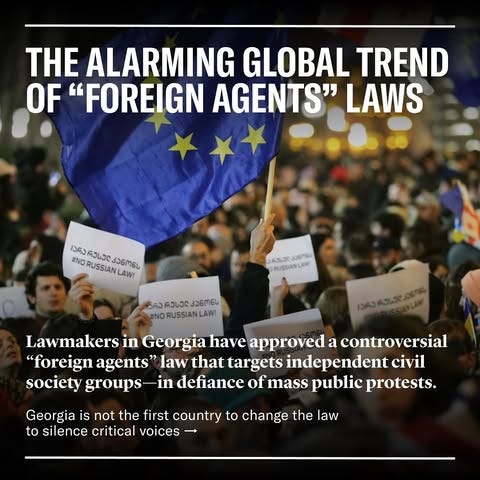
The government has continued to implement oppressive laws. In December they implemented a harsh anti-LGBTQ+ law which cracks down on the rights of queer people.
It's not even about EU integration anymore, it’s about total authoritarianism.
How have the police and the authorities responded to the protests?
In the first few hours the police were just standing there, but soon they realised that they needed to bring out more ‘robo cops’, police with ‘riot’ gear: They came out with water cannons, tear gas, some rubber bullets.
The first two days it was really chaotic, including us attacking them, and most of the police didn’t respond too violently, but there were the anomalies who were really enraged. Their tactic was to wait for us and grab us one by one and beat us up, and then sometimes send us in an empty bus and drop us without our phones in the outskirts of Tbilisi or take you to a police station and you’d stay there.
Even major figures in the political opposition have been followed home and beaten up.
[This has occurred in the context of a history of violence by police, and state funded mercenaries, particularly since the 2023 protests. Additionally, on the 14th of April, the Legal Issues Committee approved amendments to ban opposition parties and political donations, further consolidating the slide to authoritarianism].
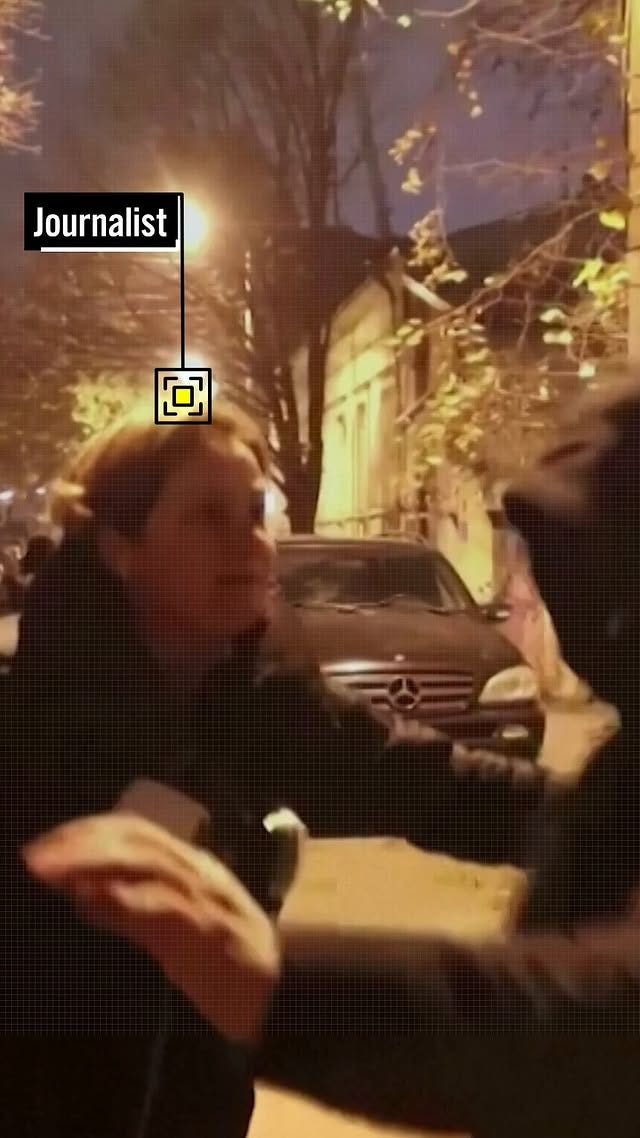
They’re also trying to make it harder to protest.
They imposed a ₾5,000 fine (around $2,000) for demonstrators. I know a woman who has been fined seven times, 5,000 x 7 is a lot of money and there’s no way she’ll be able to pay that off. And now, the government has blocked all the funds we’ve had to support detained protesters.
They also have put in restrictions on wearing face masks, all these things to make protesting more difficult.
How are you keeping momentum in the face of this repression?
The first major protests only lasted for two weeks, from late October, after the election, to early November, and it was mostly peaceful.
Then, after the Prime Minister’s speech, it became bigger, 200-300,000 people. From the 13th of November to 10th of December these demonstrations happened almost daily, those were the biggest protests that happened, and then it kind of died down. Now the protests are much smaller.
This is a direct result of the severe beatings and restrictions put in place by the government.
So, were any of the aims of the protests achieved?
Unfortunately no, inside Georgia it’s getting more authoritarian, day by day.
The only positive change is that the whole world is seeing our government as a pro-Russian authoritarian regime. That’s the only plus. Now governments have implemented some sanctions on them, and they have real impact. Just today one of the government politicians said that ‘sanctions are the modern day cannons being thrown at Georgia’.
What’s the media coverage been like, inside and outside of Georgia?
Inside of Georgia, there’s pro-government TV channels, and there’s opposition channels. On pro-government channels, the suppression of the protests is presented as prevailing against an insurrection from the ‘Global War Party’ (the term the Prime Minister is using to describe our movement). They use lots of the same narratives that the far right is deploying across the world right now.
The opposition channels everyday are filming real stuff that’s going on, but they are facing repression and violence too.
A pattern I’ve noticed in media outside of Georgia is that at the beginning it was presented as ‘The Georgia people are uniting against the authoritarian government and they will win this fight’. But now it’s turning to ‘Has Georgia fallen? Was Georgia an unsuccessful revolution?’.
And you kind of agree with that, because it doesn’t feel hopeful right now.
What can people outside of Georgia do?
Because protesters are afraid of going out because they could be fined, we need donations for these legal fines. [But] you, and other people who send money, and I, could be labelled as foreign agents so we’ll try to figure out a way round that!
Also spreading awareness is important. 80% of people right now are just continuing to live their normal lives: in the 21st century you can lose yourself in the internet, and not live in the reality of what’s happening.
Should we keep your name anonymous?
Don’t worry – just call me Georges from Tbilisi.
If I’m worried about my safety then it means like […he trails off] why am I even still protesting?
Follow Civil Georgia for English-language updates on Georgian politics.
Be part of the EUChangers program!

Sign up for an interactive and practical two-day training drawing from multiple cases on EU decision-making and influencing with Marc-Olivier Herman (EUChanger), Joost Mulder (Better Europe), Francesca Gater (ZOE Institute for Future-fit Economies) and insiders from the EU institutions.
Price: € 412,40 (excl. 21% VAT) - €499 (incl. 21% VAT). We are able to offer some pro bono spaces. If the fee is an issue for you and you are a young graduate with a keen interest in the EU and eager to work for the public interest, send us an email at euacademy@euchanger.org.
Book your sponsored slot by emailing wearethegreenfix@gmail.com.
So Now What Do I Do?
LEARN SOMETHING
Learn how to call out greenwashing bullshit! Free webinar by Creatives for Climate tomorrow 17 April @ 20h CEST.
Register for this 3-hour free workshop on fundraising for nonprofits on the 23 April @ 18 CEST.
Check out this new podcast Life at 1.2 Degrees, interviewing people living at the frontlines of climate change.
DO SOMETHING
Find out how you can get involved in Fashion Revolution Week next week!
Social impact leaders can apply for funding & training by the Elevate Prize until the 18 April.
Brussels: NGO employees can join the next trade union meeting on the 23rd April in the EPSU office at 18h.
Apply to join an in-person changemaker facilitation training in Italy! Deadline 4 May.
Stay in the loop
You can follow us on Instagram @thegreenfix_ . Bluesky @thegreenfix.blsky.social and LinkedIn. Connect with Cass on Instagram @cass.hebron, Bluesky @casshebron.bsky.social and LinkedIn.