

Polyamory and anti-capitalism: On living & loving differently
Part 1: How the state hijacked our love life

This email is unlocked for all subscribers. Usually, A Rough Idea is a series of personal essays for paid subscribers only. To access all our paid content, please become a paid subscriber.
And for those who don’t have the means to afford paid subscription, just email us at wearethegreenfix@gmail.com with ‘Gift subscription’ in the headline (we won’t ask you to prove it).
I asked both monogamous and polyamorous friends and acquaintances for their anecdotal experiences of the same questions on relationships: 1. What relationship ideas have you had to change over your life? 2. Do you think you’re mono/polyamorous by choice or by identity? 3. Have you faced any stigma for being monogamous/polyamorous? Some names have been changed.
Definition of polyamory: Engaging in multiple romantic relationships at the same time, with the consent of everyone involved.
I once dated a man who had a long-term, serious girlfriend. She knew all about me, and I knew all about her. He shared their ups and downs as we grabbed a drink in dark late-night bars in the cold Belgian winters. I could hear in his voice how their love had been long, fought-for, navigated and sustained.
I felt mainly indifferent to his polyamory. At the time I didn’t need or want, particularly, a ‘boyfriend,’ but I enjoyed his company. Just like I enjoyed swapping Instas with the cute barista at the cafe I would cycle to each morning with my laptop. And meeting with my friend for late-night coffees. She was ‘just’ a friend but I definitely never met my friends this often and texted back so fast.
All of them were polyamorous, a fact I registered as a curiosity - must be something in the water in this town. They talked to me about the highs and the lows of their relationships and I learnt all the jargon: couple’s privilege, meta, polycule, and I learnt that an open relationship is not the same as polyamory, obviously.
It all sounded very complicated. Honestly, I just wanted to have fun meeting people. (Oh yeah, I was that person. Keeping it casual. No labels. Let’s just see where it goes. Avoidant. You’ve probably had to go to therapy to get over people like me).
I didn’t want the weight of an Official Relationship, something I associated with a man collapsing the roles of a whole social network into one and thrusting it on me: friend, girlfriend, therapist, mother, travel partner, cleaner, source of all his woes and the person responsible for fixing them.
Stanford researchers even came up for a word for this phenomenon of filling in all the gaps in a man’s social circle for him: mankeeping.
There’s a lot pressure with being a partner sometimes, especially if you bring some neurodivergence into the mix. Not only are you a lover, you are also a friend, support and caretaker. If it takes a village to raise a child, what does it take to support an adult? Wolfgang, polyamorous
I assumed that eventually I’d return to that, as all of us must, to secure the coveted status of a Settled Stable Relationship, with the approval of our families, society and the government, who will note down our status for legal purposes.
Polyamory, I surmised, was not a sustainable long-term situation. It seemed to involve too many Google Calendar logistics and conversations about boundaries and preferences that rivalled UN high-level conferences in their complexity.
As well as a multiplied risk of heartbreak. One day my friend messaged that both her girlfriend and her boyfriend had broken up with her, and we sat in a crowded hipster cafe as I tried to console her with my insufficient, Westernised views on relationships.
“At least you don’t have to choose which one to go on holiday with?” I offered. She cried.
After a while of me coasting along in my various no-labels keeping-it-casual situations, the guy I was seeing asked me to meet his girlfriend. Maybe we would hit it off. Maybe this could be something more.
I dealt with this as I dealt with all personal issues at that age: terribly.
I rushed to my friends, panicking that it was ‘suddenly’ getting real. (Curious that I often see polyamorous people cast as non-committal when all I encountered was people ready to tackle a mountain of complexity in order to date someone they liked, and I was the one running away).
“Oh yeah, that sounds so complicated,” one monogamous friend said. “Poly is so messy.”
“It’s not that,” I said. “I just don’t know if I want something serious right now and a serious poly relationship is like…. extra serious. Like a part-time job.”
Another friend said, “Well he already has a girlfriend, so I don’t think he’ll mind if you end it.”
And I said, “Well I have more than one good friend but it still would hurt if one cut me off because she didn’t like me enough. There is no ceiling or quota for love.”
Over time, I met other non-monogamous people and I could put theory into practice. I learnt that my partners falling in love with others, really did not mean that I was less loved. Love is not rare or more special if it is artificially treated as a restricted resource. Lydia, polyamorous
Mainly people said, wow I could never do that. They listened to my (rather tame) stories and my overthinking with the expressions of people who are confident that their monogamous situationships with manchildren and jealous girlfriends and people who don’t text back are Better. The Right Way.
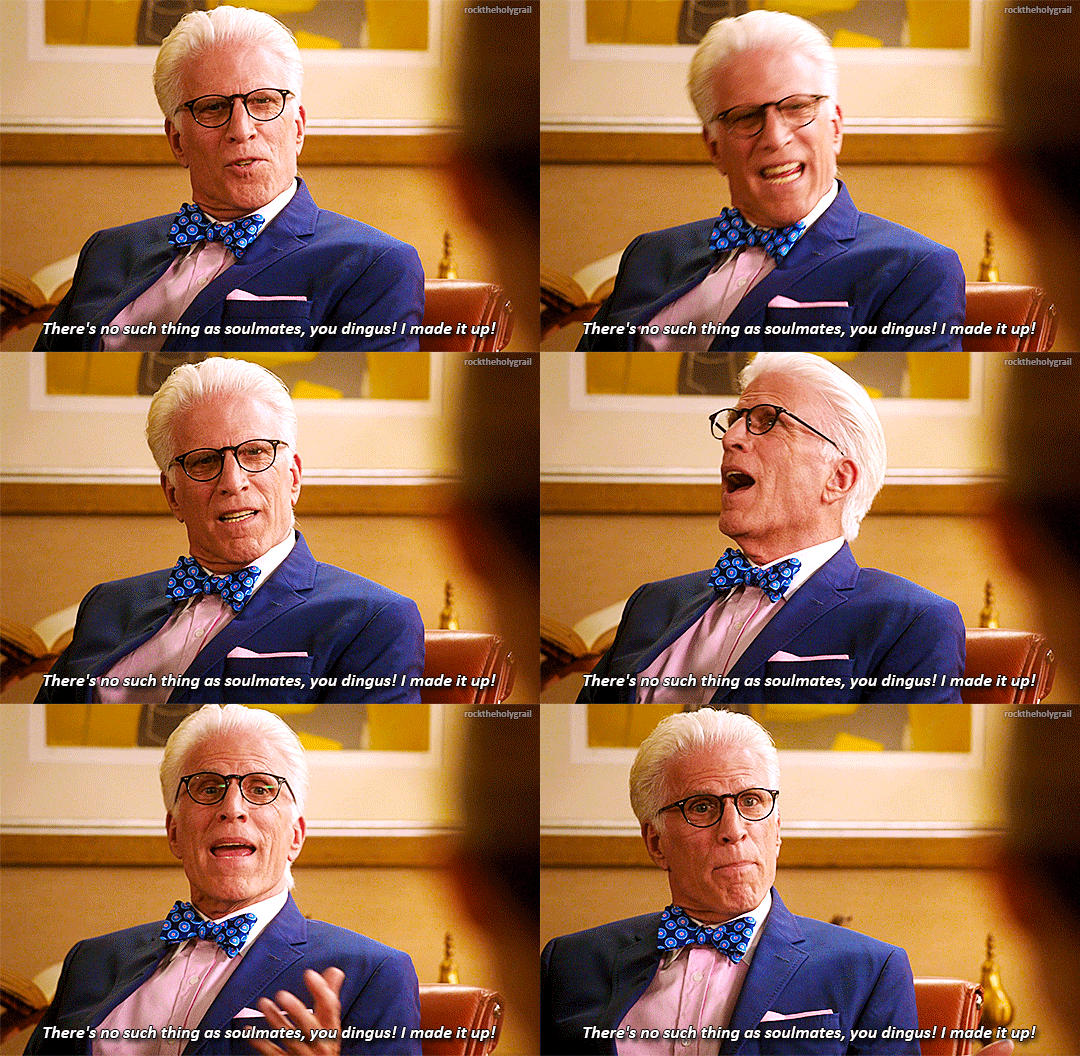
Only one problematic person at a time is the way to go. Just like Hollywood taught us, along with unrealistic body standards, the belief that life will fall into place when you meet someone. No, not someone. The One.
When I was young, I was under the illusion of perfect soulmate romantic love. This love on the one side requires the other to choose you freely, but on the other side to transform this choice into a necessity (the other cannot not choose you). That’s a paradox. I think overcoming this is necessary to form healthy relationships. Jonathan, monogamous
I found myself getting irritated with my friends who didn’t help, but were keen to hear more about how the decision-making was going, like they were subscribing to a crazy drama, a soap to relish from the safety of socially acceptable relationships. I felt like a sudden unwitting spokesperson for, and defender of, a relationship structure I was essentially observing from the periphery.
And then on the other side, some of my particularly activist-y friends despaired that they ‘should’ embrace polyamory because it would, in their view, be the left-wing thing to ignore their own boundaries and dismiss their own happiness, for the Cause. Discussions on relationship styles quickly devolved into ideological posturing.
The cultural fixation on the nuclear family
I understand it. How many conservative polyamorous people have you met? Any alternative to the state-approved status quo is usually treated as radical by default. But do we believe that, or are we just repeating what we’re told?
Poly instead of monogamous just means that the limits are not set up by pre-determined social norms, but by a continuous conversation with the people I’m romantically connected to on the love, time and attention we desire from each other and the freedom we give each other. Julie, polyamorous
After centuries of patriarchy, religion and the capitalist and downright disturbing right-wing fixation on reproduction that sustains the worker supply, the hegemony of the nuclear family has become unquestioned. It’s even experiencing a revival in the form of the manosphere and ‘tradwife’ content. It harks to a fictional past where women were content to submit to their husbands in sourdough-making child-rearing no-voting-rights bliss.
In reality, Gen Z men are currently more conversative than Boomers in their views on gender roles in relationships.

Pursuit of the nuclear family is framed not as a choice but as a moral imperative, a safety net and the end goal. And when alternatives to the monogamous heterosexual married-house-kids prescription are presented, the existing structure aims to drag them under its umbrella. And so gay relationships were seen as legitimate only when gay people could legally marry in a church. Indeed, the backlash against gay marriage frequently devolves into debate about whether it’s a ‘real’ marriage, reality itself now being decided by the government and society rather than existence of the thing in question.
A victory for LGBTQ+ rights, no question, but a victory within the channels of a system that does not embrace newcomers so much as assimilate them.
Our culture has taught us to assign hierarchy and superiority to relationships that are recognised by the state. As Lisa Sibbett put it, “The nuclear family is a relatively new social construct that benefits wealth and power and capitalism but does not benefit children or families or parents or non-parents or communities or the planet.”
Monogamy as an economic strategy
We often speak of marriage as an institution that was once rooted in economic and social strategy - providing women with opportunity and access through their husbands - but has now become a celebration of love. But in many ways, the monogamous marriage or civil partnership is still primarily an economic proposition.
It is easier to get tax breaks, it is easier to get a visa or green card with a state-approved marriage to a citizen of that country. It is easier to be monogamous. Not easy, but easier. The state legitimises it. Hollywood tells us that we are only half a person, seeking our other half, our soulmate, who we should devote our time and money to finding.
The people with the most money seem deeply concerned with pushing a dependency on romance and True Love for fulfilment (rather than seeking it through, say, a liveable salary or access to healthcare or green spaces). Monogamy predates capitalism, but capitalism has turned it into a profitable commodity.
For me the issue stands on the myth that romantic love is the superior one that completes us. So we’re taught that we need to give it all of our time. Aside from the fact that we should toss our friends to the side to give more time to “Love”, it also puts out this idea of this superior force that will solve all our problems if and when we find the One True Love. Louis, polyamorous
Patriarchy and monogamy
On top of that, religious social roots and its embedded misogyny teach us that our bodies are temples and prize the virginal and innocent women - a trend that continues in the form of a popular porn category for men. Men continue to prefer us untouched and defenseless until they choose otherwise. Celeste Davis describes this as a tension between fraternity culture which sees women as sex objects to be used, and purity culture that sees women as sex objects to be avoided.
By establishing fixed rules about how, when and with who a woman can enter into a relationship and reproduce, men in power continue to tell us what and who we should want, rather than reflect the messy, complex reality of our lived experiences.
The result? Aside from a long trail of abusive and rushed marriages, the normalisation of mankeeping and the commercialisation of romance, we are taught to ditch the community and crave copendency. We say I’m yours / I only need you / I can’t live without you as if they are romantic - and turn ourselves into objects, incomplete humans. 50% of a person.
Monogamy then, even unwittingly, risks becomes a tool for gatekeeping women’s sex and love lives that plays into the idea that women are objects that ‘belong’ to (one) man.
I used to be in a very monogamous relationship for six years that came with all the negative traits associated to it (unreasonable jealousy and posessiveness, etc) and it made me feel very claustrophobic and made me long for a non-monogamous relationship, which I had in my current relationship for the first half year and afterwards we closed it.
I think those experiences taught me that I didn’t actually long for a non-monogamous relationship, but to connect more deeply and intimately with my friends within a monogamous relationship, to not constrict myself in playfulness and curiosity with people that are not my partner. Joren, monogamous
My partner has two other partners, and I’m blessed with knowing them both as beautiful human beings. What does this also bring? When times are tough, the person I love has 3 dedicated people to rely on. Wolfgang, polyamorous
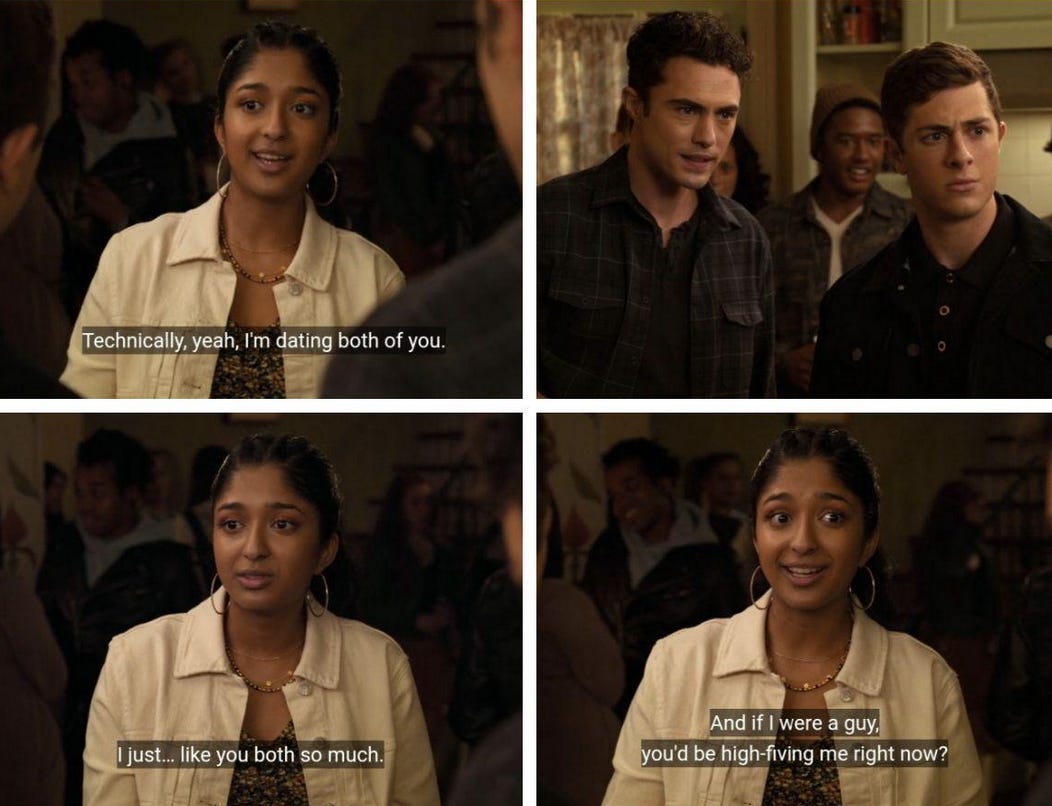
I have to warn you - once you start reading about these things, you can’t unsee it. Now when I watch TV shows where the main character agonises about which man to choose (usually a Boring Decent Guy vs Rebellious Bad Boy), I wonder - why not both? And people laugh as if I’m telling a great joke.
I’m not here to make a case for or against polyamory. It’s not useful to discuss which relationship style ‘works best.’ Evidence shows that levels of fulfilment in consensual and healthy monogamous and polyamorous relationships are around the same. I want to confront and highlight how many of our beliefs about the way the world works come from the social scripts we grew up with. And the way we unintentionally defend ideas that aren’t even our own. It’s easy to sleepwalk according to the script and never realise that our beliefs and preferences could be different.
Do you really prefer the stresses and the work of relying on one partner, or are you just afraid of trying anything else? Do you really want to fuck multiple people, or do you want to fuck the system?
And importantly - how could all our relationships improve by shedding the Hollywood bullshit that prescribes what our love should look like?
Part 2 coming soon.
Cover art by Emily J Moore: Hands
👏🏼👏🏼👏🏼
I'd probably have more love to give with more access to green spaces.🍃 Have I been oppressed into monogamy? 😂Great read, thank you for widening my view.