

Meet the Indigenous women who successfully staved off gold miners in Ecuador
Squad goals tbh.

Tonight! Join the Brussels Climate Drinks

Today, the 28th January, in Mazette, from 18h. Pass by for a drink with other people who care about the climate. Networking optional. (Sitting in the corner in stoic silence is also fine). Details here.
Coming Up: Activist Speed Dating - 18th February

Yes, actual, holding-hands and spaghetti-sharing dating. Our Speed Dating is for activists of all genders and orientations who want to date people who actually show up for protests. (It is a movement of rage and love, after all ;)). Details & registration here.
A Re-Introduction to The Green Fix
I started The Green Fix five years ago to ‘share information on sustainability for eco-conscious readers.’ Everything has changed. Our subscribers have changed - and grown. Our goals have changed. A reintroduction is in order.
I’m Cass. I’m a climate activist, mainly. I’m one of those people that sits in cafes sipping an oat cappuccino with political stickers all over my laptop while older people tut that we’re all glued to our screens these days. I am outraged on social media (connect, if you want). Leftwing snowflake/woke police/naive young woman. Pick your insult, I’ll make it my own.
When I started The Green Fix, I was a trainee in an NGO in Brussels with a lot of drive, a people-pleasing and perfectionist tendency, and hardly any knowledge. I had only the vaguest understanding of theories of system change, intersectionality and all the other vocab we pick up along the way. I wanted, as most of us do, to Make A Difference.
Now we are different. We are a ‘we,’ firstly. We’ve become a team of volunteers based around Western Europe with a united interest in helping build a fairer, more sustainable world.
I’ve also got five more years of experience working in NGOs and with grassroots groups. I’ve gone to multiple UN conferences (and quit a few, too). I went viral for earning less than minimum wage. I’ve attended trainings on system change, effective activism and depolarisation until I was asked to start providing them. I still feel like I know very little.
We are more political, more outspoken, more confident.
We see The Green Fix not as a commentator but as an active tool to support activists and speak out against injustice. The climate crisis is inseparable from the rise of fascism and the far-right, the defence of gender justice, and the pursuit of decolonised futures.
They share one root cause: A group of (mainly male, mainly white) rich people profiting from a capitalism and neoliberal system that rewards those who invest in climate devastation, conflict and exploitation.
The fight for a fairer future is not between the right and left, it is between the richest 0.1%, and everyone else.
Here’s how we can work together:
We are always looking for underrepresented voices and campaigns to interview or spotlight. Please reach out to us with campaigns, people, events and resources you want to highlight. You can also tag us on Instagram, LinkedIn and Bluesky with resources you’d like us to reshare.
Join our events that aim to bring the climate movement together. They’re mainly in Brussels but we’re open to collaborations in other cities.
Subscribe to our paid bonus editions for more personal reflections on life as an activist in a capitalist society. All our work is funded by reader donations.
And we’re always open to hearing whatever else you want us to address. Share your thoughts:
What’s Going On?
In Bangladesh, thousands of volunteers are battling climate-fueled disease at its source.
Heat inequality: Study measures the toll of climate change in Rio de Janeiro favelas.
If you’d like to support The Green Fix, please consider becoming a paid subscriber to receive extra essays on climate justice in everyday life. You can also tip us a virtual coffee.
Focus On: Yuturi Warmi
We talked to the Margot Tjolle and the Yuturi Warmi community in the Ecuadorian Amazon about their documentary to highlight the movement against gold mining projects. Quotes from the Yuturi Warmi are translated.
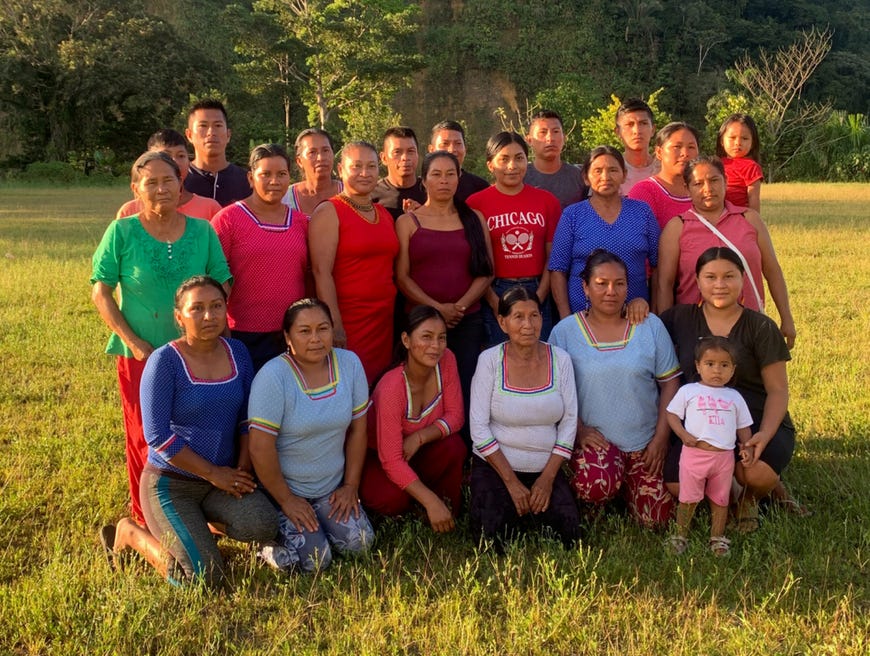
Margot: I’m Margot, a Belgian degrowth organiser, storyteller and community weaver based in Copenhagen, where I have lived for the past 4.5 years. I hold a Bachelor’s degree in Political Science and a Master’s in Environment and Development from the University of Copenhagen.
I focus on bringing communities together and mobilising across interconnected struggles, including anti-extractivism and pro-Palestine movements.
Rooted in climate justice and decolonial perspectives, my activism challenges hegemonic institutions at the imperial core, while standing in solidarity with frontline communities resisting systemic violence and extractivism.
Who are the Yuturi Warmi?
Margot: The Ecuadorian Amazon, especially the Napo province, is plagued by the scourge of industrial gold mining since the pandemic in 2019. Not only does gold mining lead to deforestation and contamination of their bodies, soils and rivers by toxic chemicals, predominantly mercury, it also brings organised crime, drug abuse and trafficking and prostitution to the communities affected.
This is what Yuturi Warmi is fighting against. They are the first women-led Indigenous Guard in the Napo province of Ecuador. Yuturi Warmi directly translates from Kichwa to “conga woman”, “conga” being a certain species of ants which are considered warriors in the Kichwa culture. Conga ants are peaceful until their territory gets threatened: if an unwelcome presence gets close to their nest, they unite and bite the individual to defend themselves. They are a group of around 70 community members of the Serena community, women-led but now also their husbands joined.
Sonia, Yuturi Warmi: When mining comes in, everything is destroyed. The animals are no longer here because the jungle is damaged, and with that noise the animals go far away. Even if we go hunting, we don’t find anything because the animals are gone. On the other hand, when they go to the river, when the fish get in contact with diesel, grease or mercury, they get contaminated and we can’t eat them.
Why is it women leading the resistance against gold mining?
Piedad Alvarado: There’s some men that get home from work, they go take a bath and go to bed to rest. Whereas we have to come back home to cook, do laundry, take care of the kids… We have to do everything.
Margot: Due to the patriarchal gendered division of labour and reproductive work in the community, the women are the ones who are impacted the most by the contamination and violence that miners bring once they start digging for gold. Women do the cooking, cleaning, taking care of the children (bathing them in the river), collecting water, doing agriculture (growing food), etc.
This also gave them the incentive to form a group to stop the miners from entering their territory. The women see themselves and future generations intertwined with their territory, as their well-being depends on its integrity, also known as cuerpo-territorio.
Patriarchal violence existed before the era of gold-mining and even increased when the women first started organising, making artisanal jewellery to make their own alternative income and going to protests.
Elsa Cerda: Before, machismo was terrible in my own community because our husbands did not give us permission to go to a meeting. The leaders were only men. If a woman said something, they would catch her and beat her. They would say: “you go [to the meetings] just to be with another man [to cheat], just to gossip.” So women lived in fear, terror.
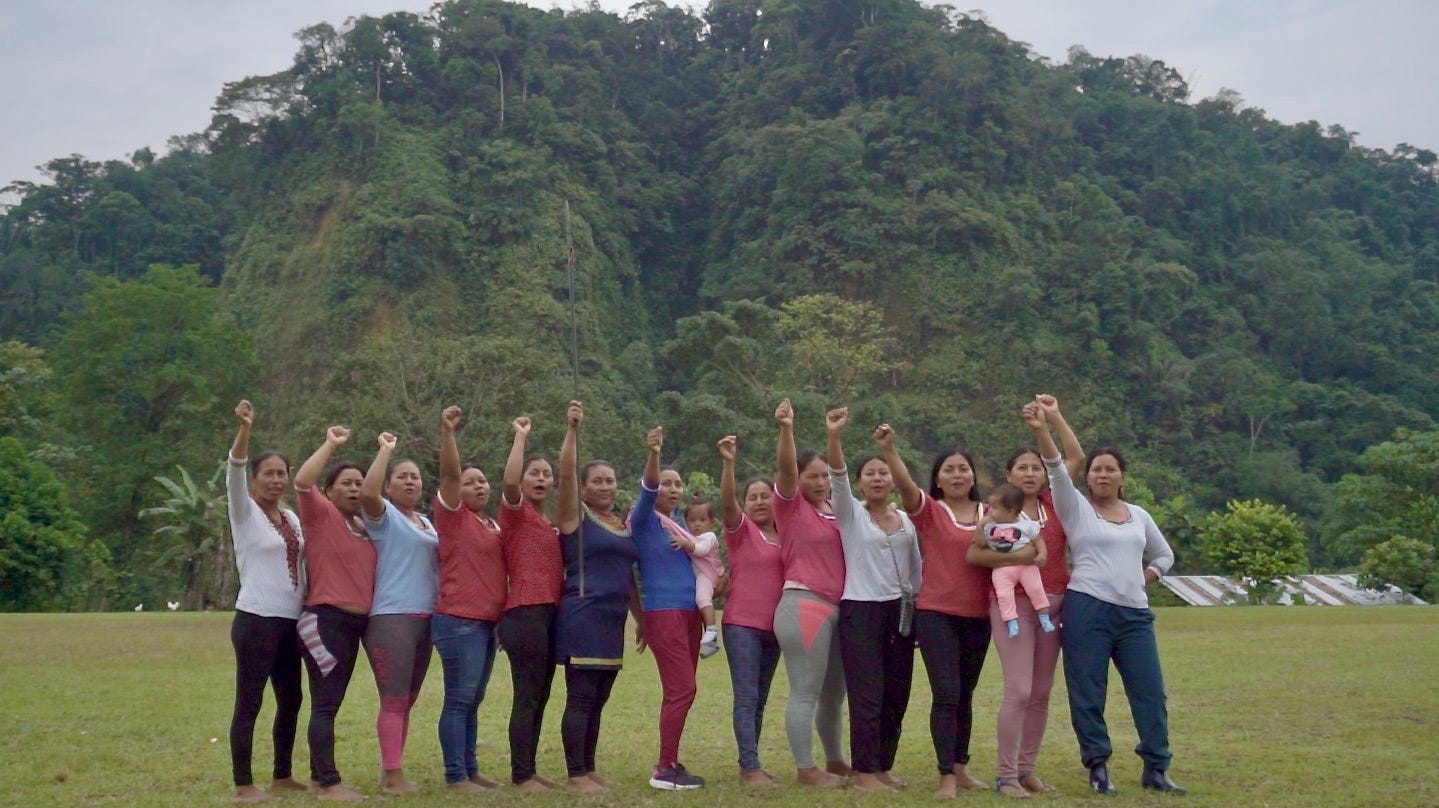
Marisol: All the women here were mistreated a lot. We came together and told each other that this should not be. And little by little I also became stronger. And he [my husband] understood things too. I told him, you shouldn’t do that. Now, when I’m weaving like this, he comes back and says, I’m going to cook.
Yolanda: Thanks to Yuturi, we are all empowered women. And that’s what Yuturi brought us: it opened the mind of each women that not only men have the courage to say: “you can’t do it, we’re not for this...”. Yuturi women are involved in directives as well. Before it was only men.
What victories have the Yuturi Warmi had?
Margot: Aside from collective empowerment of the women and a change in gendered division of labour, the Yuturi Warmi have successfully been able to keep out miners from entering their territory, and safeguarded the life of all living beings in their community.
They have also been able to reach quite a global outreach through articles in the BBC and El Pais. Their dream is to start a community tourism project with which they can stay in their community, provide jobs for everyone, preserve ancestral practices and knowledge which they combine with new and ‘modern’ ways such as tourism.
They have successfully also built a botanical garden with their medicinal plants to teach their husbands, kids and visitors about their use and related customs. I have been able to sell a lot of their artisanal jewellery aswell (around $4000) through my screening tour.
Where did the documentary idea come from?
Margot: The seed for the documentary was sown in 2024, when l and two fellow students from the University of Copenhagen – Marie Eenens from Brussels and Filippo De Rossi from Venice – travelled to Ecuador to conduct field research for their Master’s thesis in Environment and Development. In the village of Serena, in the heart of the Amazon rainforest, we worked with the Yuturi Warmi community for three months. We didn’t want to conduct research about them, but with them.
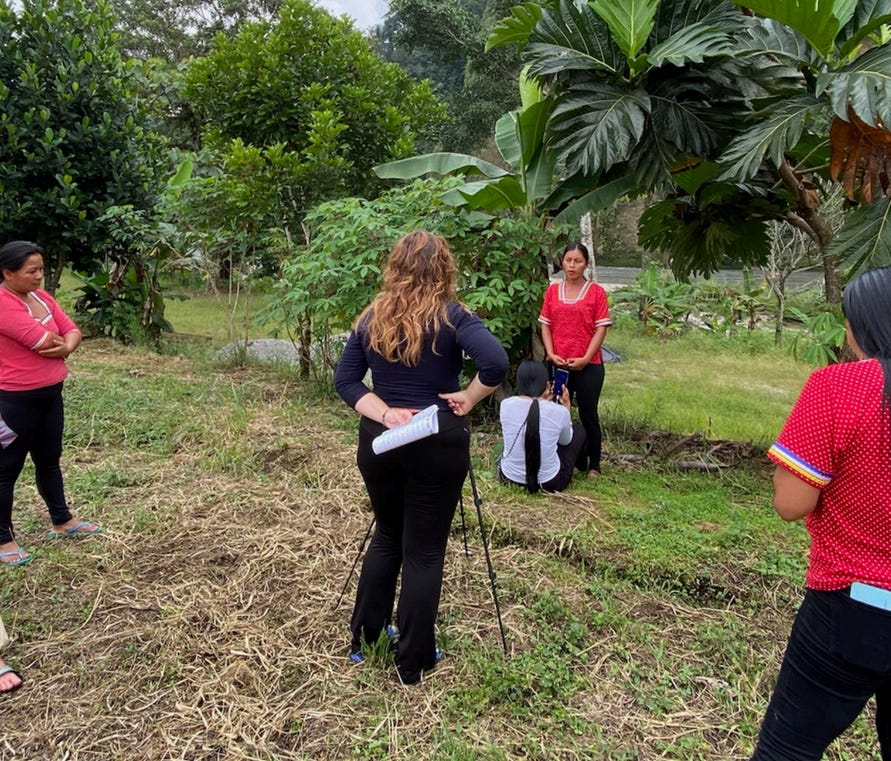
They gave their time, knowledge, and trust, and in return, we wanted to give something back that was meaningful to them. This reciprocity led to the idea for the film. The women asked us to capture their stories and help share them in Europe.
I happened to have just bought a secondhand camera in Copenhagen. Without much preparation, I started filming. We primarily wanted to show who they are, not just the misery they face.
After the initial trip, it became clear that crucial footage was still missing. I decided to return to Ecuador alone in 2025. I wanted to finish the documentary with them, not alone behind a computer in Europe. The two months with Serena were intense, but also beautiful. I truly felt part of their family.
Did you face any challenges in creating the documentary?
Margot: I have never made a movie before so it was definitely a challenge trying to figure out how the camera works, what to film, how the editing software works, how to do colour grading, sound engineering… many things.
Everything was self-funded as well, I didn’t have the time to apply for any funds before the project. But luckily I have an a amazing network of comrades in Europe who have offered to help with organising screenings in their hometowns and giving me advice on which film festivals to apply for.
How can citizens in Europe support Yuturi Warmi?
You can help by sharing their story on social media, donating to their crowdfunding, buy their handmade jewellery (contact margot.tjolle@hotmail.com), help with research about the companies involved and the supply chain of gold.
Corina: I will go into history, I tell you, that Mama Curi died like this for herself, for her community. […] I want to fight for my children who are going to be left here, for my grandchildren.
You can follow see upcoming screenings around Europe, or help organise one in your city, on the documentary website.
So Now What Do I Do?
LEARN SOMETHING
Read: The Guardians of the Amazon, in the Green European Journal.
Sign up for this online interactive course on capitalism vs love by the 3rd February. [1000 USD, scholarships available].
Watch: Speech by Canadian Prime Minister Mark Carney at Davos declaring the end of the old world order.
DO SOMETHING
Nominations for the Gulbenkian Prize for Humanity are open! Nominate an activist you admire by the 30th January.
Brussels: Calling all heavy metal fans! Get your ticket for this night of Slow Fashion & Fast Music on the 31st January.
Aged 18-30? Sign up for the Climate Resilience Weekender in the UK! Deadline to apply is 31st January.
Stay in the loop
You can follow us on Instagram, Bluesky and LinkedIn. Connect with Cass on Instagram and LinkedIn.