

Polyamory and capitalism #2: On living & loving differently
Part 2: Love with an abundance mindset

This email is unlocked for all subscribers. Usually, A Rough Idea is a series of personal essays for paid subscribers only. To access all our paid content, please become a paid subscriber.
And for those who don’t have the means to afford paid subscription, just email us at wearethegreenfix@gmail.com with ‘Gift subscription’ in the headline (we won’t ask you to prove it).
I asked both monogamous and polyamorous friends and acquaintances for their anecdotal experiences of the same questions on relationships: 1. What relationship ideas have you had to change over your life? 2. Do you think you’re mono/polyamorous by choice or by identity? 3. Have you faced any stigma for being monogamous/polyamorous? Some names have been changed.
Definition of polyamory: Engaging in multiple romantic relationships at the same time, with the consent of everyone involved.
Do you remember how your last relationship ended? Of course you do. Did it feel like a failure? Did you worry about being alone forever? Or was it a relief?
In part 1 of this essay-meets-massive-overshare, I talked about how monogamy and the nuclear family became embedded in our Western societies as the default, the end goal, the proof of success of being a Person In Today’s Society.
But it’s easy to critique the status quo. (Other than the part where I post these articles on LinkedIn and Substack). It’s harder to consciously choose a different path, or to intentionally choose monogamy and more traditional routes. Especially if you don’t really know or understand that you can make the choice at all.
Nothing has shaped my ability to make autonomous relationship choices and dispel myths fed to me by Hollywood and society as much as dating and befriending people in a range of different relationship structures. Polyamorous people, people in open relationships, people who stay single by choice, people who want to have a child alone, or raise it in a shared house with their friends.
People who are, at the end of the day, just trying to live their lives, but in doing so present a necessary challenge to the hegemony of patriarchal, neoliberal and conservative beliefs that unconsciously shape our ideas of what love and connection must look like.
By addressing these entrenched myths, and opening ourselves to alternative attitudes and approaches, we hopefully can begin to sift through the propaganda to our true preferences and desires.
Do relationships really ‘fail’?
There are many critiques of polyamory. The one I hear most often - usually by people who have neither experienced nor met anyone polyamorous but have read some horror stories online - is oh but that never works.
If we mean ‘works’ in the sense of lasting forever, then yes, most polyamorous relationships ‘fail.’ Most monogamous relationships also end. Because most relationships end.
I couldn’t find data on how many romantic relationships in a lifetime are the average (which perhaps says something about how we still value marriage more than romance). But in the UK, 41% of marriages end in divorce. In Finland, Norway and France, that goes up to over half of marriages.
For me marriage, which is a commitment to try to stay together, while recognising that that is certainly not a given, maybe not even natural, is absurd. But that makes it all the more valuable to me. But I have to admit, it would be intellectually more honest to say: we agree on this marriage contract for five years and let’s see where we stand then…. Jonathan, monogamous
The fixation on relationships lasting forever to be ‘successful’ is often paired with a strong social stigma against being single. A study by Match in 2022 of 1,000 single people found that over half of them had recently experienced ‘single-shaming’, regardless of whether they were happy single or not. I’m sure many of us when single have heard people reassure us that it’s ‘OK’ or ‘there’s still time!’ when that was not a question we were asking.
Just like in polyamorous structures, single people find themselves facing the age-old socially prescribed myth that fulfilment must come from a two-person romantic relationship. The relationship that a capitalist neoliberal economy promotes (partnered people frequently find that they gain financial and legal benefits from a traditional marriage) and that history has required (when women were property and needed marriage for any chance of financial stability and security).
The flipside of the ‘happily ever after’ socially-prescribed goal is a long history of singleness - particularly in women - being stigmatised, framed as a failure, a deficiency or a sign of loose morality.
No wonder breakups are maligned. But let’s flip the script. What if breakups are a success story?
Before I met my first poly friends, I never questioned seeing a breakup as a failure. But after her breakups with her boyfriend and girlfriend, one friend said that it hurt like hell, but it was worth it. She had the privilege to love and be loved by so many people - whether for a short time or a long time.
Of course it still hurts. In a culture that tells us that pain and discomfort is always bad, something as visceral as a breakup can feel like a betrayal from the world that promised a happily ever after.

But our fear of discomfort may be the problem, more than the discomfort itself. The poet Khalil Gibran once said, “Your pain is the breaking of the shell that encloses your understanding.” Some people grow together in their relationship, sometimes they grow apart - but as long as you’re growing, isn’t that a success?
Think back to your last relationship. Maybe it was a shitty relationship and he got angry if you weren’t constantly texting him, or she made fun of you in front of her friends. Maybe it was abusive. Getting out was the best thing you could do. That’s a victory.
Maybe it was a good relationship. I have some exes I can’t say much bad about except that we grew apart as we changed. Yet I learned things from each of them. Those good memories and new knowledge aren’t erased by the relationship ending. Leaving on good terms is surely a victory too.
The typical indicator for “successful” marriage, from what I learned during my upbringing, would be if the relationship had ended with one or both of our deaths. This was the first idea I unlearned. When I look back on my first marriage, the overwhelming emotion I feel is gratitude; that experience prepared me to be the person who was ready to meet my soulmate. Sara, polyamorous
I mentioned in the first part, that I once dated a polyamorous man who wanted to get more serious. That relationship ended, but it had nothing to do with polyamory. He cast some of these social scripts into the light for me, and he is one of the people I asked for quotes for these articles. He, along with others, fundamentally reshaped how I approach relationships.
Sometimes relationships don’t fail or end, they just transform.
The fear of scarcity
But Cass, you might be saying, I can’t believe I wasted so much time in that relationship. That’s years of my life I’m never getting back. I get it. And yes I would be better off if I had spent less time begging men to do the bare minimum.
But the fear of ‘running out’ of time to find a partner to me always echoed an underlying social script rooted in a scarcity-based economy. Under neoliberal economies, we’re taught that every resource is scarce. We must fight for jobs, save up our time and money, and compete with everyone else to be The Best and hoard the most income.
The result is a hyper-capitalist hyper-competitive society that is simultaneously obsessed with having more, being more, owning more, and convinced they will never have enough, be enough. A generation of anxious and overworked people are unlikely to lead a revolution. Hell, Gen Z are having less sex than Boomers and now say they would prefer one good night’s sleep.

And now we tell them they must find The Best Partner, the Soulmate, fast, before anyone else ‘gets’ them. And then be perfect in order to keep them. This plays out in our relationships, where we are taught to ‘own’ our partners.
Women’s magazines warn us of the perils of ‘micro-cheating’ (including sharing memes with a friend of the opposite sex before you), and ‘emotional cheating’ (being inappropriately emotionally close with someone else). Other opportunities for connection are instantly a threat to your investment, a competition to beat.
These guardrails and limitations we place on our partner’s connections often aim to assuage a deep-rooted anxiety that they have a quota for love and care that must be hoarded, for fear of not having enough for yourself.
Ever since starting non-monogamy, I’ve been confronted by this idea that I couldn’t really fall in love with two different people at the same time. And it’s one I used to share as well before learning about it. I knew I could have a crush on someone even if I was in a relationship with another person. But the idea was that if I acted on it, it would mean I didn’t love the first one. Louis, polyamorous
Love with an abundance mindset
Polyamory embraces abundance in a way that I find very anticapitalist. While there are boundaries (as I noted before, UN negotiators have got nothing on polyamorous people), it has a much more generous approach in our capacity to love.
As is often pointed out, we don’t expect to be someone’s only friend or ban them from being close to other friends. (With the exception of my ex who didn’t want to make new friends because he was afraid it would interfere with his time to chill, but frequently complained he was isolated).
Each friend brings something different to our lives. I have my friend that I can rely on for advice when organising an event, and another one I’d meet up with for their energy and enthusiasm, and another for their calm down-to-earth demeanour. Friends for a short time, friends for life. They each offered something that only they, a whole unique and irreplaceable person, could.

How can we expect one person to be all of these people and fulfill all these roles? In monogamous structures too, taking time to nurture our friendships and social ties outside of our romantic relationship is vital for our mental health and fulfilment.
By the way, I think the reason that we are not made to limit our friendships is because the patriarchal, marriage-obsessed Western culture we live in has never seen friendship as a significant or useful part of our life. Individualism disregards the power of collective action and strong networks. Indeed, they are even framed as frivolous or less important. This is wrong - I wrote about this in an earlier article.
The patriarchy has taught men that they should not need or want a social network, or build meaningful and emotionally intimate relationships with others, instead heaping all the responsibility at the feet of their often-exhausted female partner. And she had better not seek comfort or emotional closeness in anyone who may pose a ‘threat’ to the relationship. How will she, in that situation, find the time, energy or freedom to love others or be part of a community?
Perhaps unsurprisingly, a recent study found that single women are happier than single men,
[I had to unlearn] the sneakily ingrained idea of “ownership” in a relationship. When my partner started dating someone new early in our poly experience I felt that jealousy of “someone else is fucking MY partner!” As I was sole owner of them and their sexual experiences. I wasn’t treating them like an actual full individual, thinking about it in those terms takes away someone’s agency. Wolfgang, polyamorous
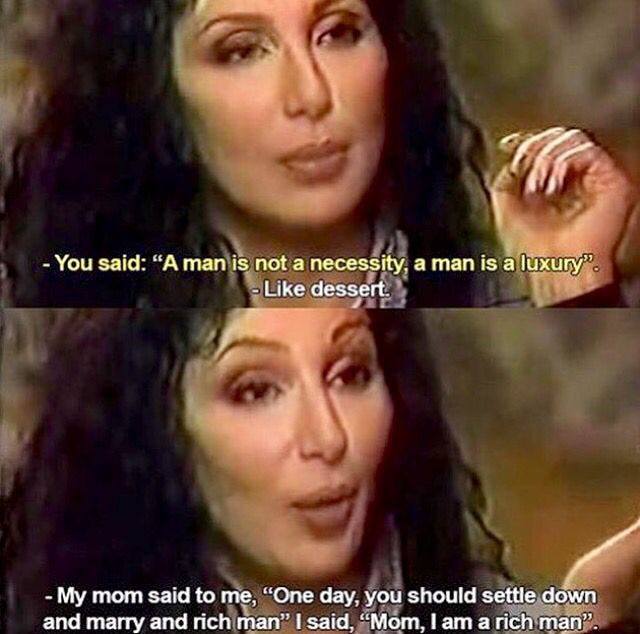
What if we all took a more polyamorous, resource-abundant approach, regardless of how many romantic partners we want to have? If we imagined that there was an abundance of people out there that we can form meaningful, reciprocal and fulfilling connections with.
That there is not one soulmate that is fixed throughout our lives but people that suit us for a short time, some for a long time. And so so many people that have the capacity and willingness to love us, help us, reveal a new way of seeing the world, and that we have the capacity to love, help, and experience life together. That we can also have love stories with friends, neighbours and people we met for just a day.
On top of that, imagine we had an abundance of time. I’m well aware that many feel the tick of a biological clock. Aside from the fact that opportunities for parenthood without a traditional relationship have expanded over the decades, it is surely still better to act as if we had the time to make intelligent, intentional relationship choices, than stay in a sinking ship out of fear of running out of time to find a lifeboat.
I have seen friends - intelligent, feminist friends - continually sacrifice their boundaries, comfort and critical thinking to salvage a relationship with people that never bother to even come to their place because it’s too much effort.
I’ve seen coworkers stay in marriages where they carry all the domestic and economic weight in the hope that their partner will eventually ‘learn’ how to step up.
I’ve heard friends complain that their friend will no longer spend time with them because their boyfriend isn’t comfortable with it.
And at some point all these conversations boil down to the hope that all this work and dissatisfaction must be worth it, because we’ve been told that being in a long-term monogamous relationship is the end goal, and so all the pains that come with it must be borne, and that that is a greater ‘success’ than breaking up. And these friends and coworkers end up spending so much time working on the relationship that their other social ties begin to disintegrate, as they try to make themselves fit into a structure that isn’t working.
Love is not rare or more special if it is artificially treated as a restricted resource. Marie, polyamorous
Again, a patriarchal and neoliberal social structure stigmatises the formation of strong social networks and communities, by placing a quota on what kinds of relationships we can have, creating the idea of scarcity of love and assigning a huge pressure to stay in and ‘fix’ socially accepted romantic relationships.
How different would our relationship stories be if we embraced an anti-capitalist mindset and imagined that there was an abundance of capacity for care, connection and meaning with or without our romantic relationships?
Part 3 coming soon (?? This is getting so long so I hope you all like reading this)